A Nation Already Looking at the Sky
To understand why Roswell shook the world, you need to understand the summer of 1947. The Second World War had ended less than two years earlier. The atomic bomb had shown that technology could do the unimaginable. The Soviet Union was becoming a new threat. And just two weeks before Roswell, on June 24, 1947, a civilian pilot named Kenneth Arnold reported seeing nine shining objects flying in formation near Mount Rainier, Washington. Newspapers coined the term "flying saucers" to describe what he saw. America was already nervous, already watching the sky.
When the Army's announcement came from New Mexico, it landed on a population that was primed to believe something extraordinary was happening.

The Man Who Found the Debris
Mac Brazel was a rancher who worked a large stretch of remote land about 75 miles north of Roswell. In early July 1947, after a stormy night, he rode out across his property and found something he couldn't explain — a wide field of scattered material. There was foil-like metallic sheets, sticks, and what he described as a kind of tough, papery substance. Some accounts mention unusual symbols or markings on some pieces. None of it looked like anything he recognized.
Brazel collected samples and drove to the town of Corona, then later to Roswell, where he reported what he had found to Sheriff George Wilcox. Wilcox contacted Roswell Army Air Field — one of the most advanced military installations in the world at that moment, and home to the 509th Bomb Group, the only unit trained to carry nuclear weapons.
The Press Release That Went Around the World
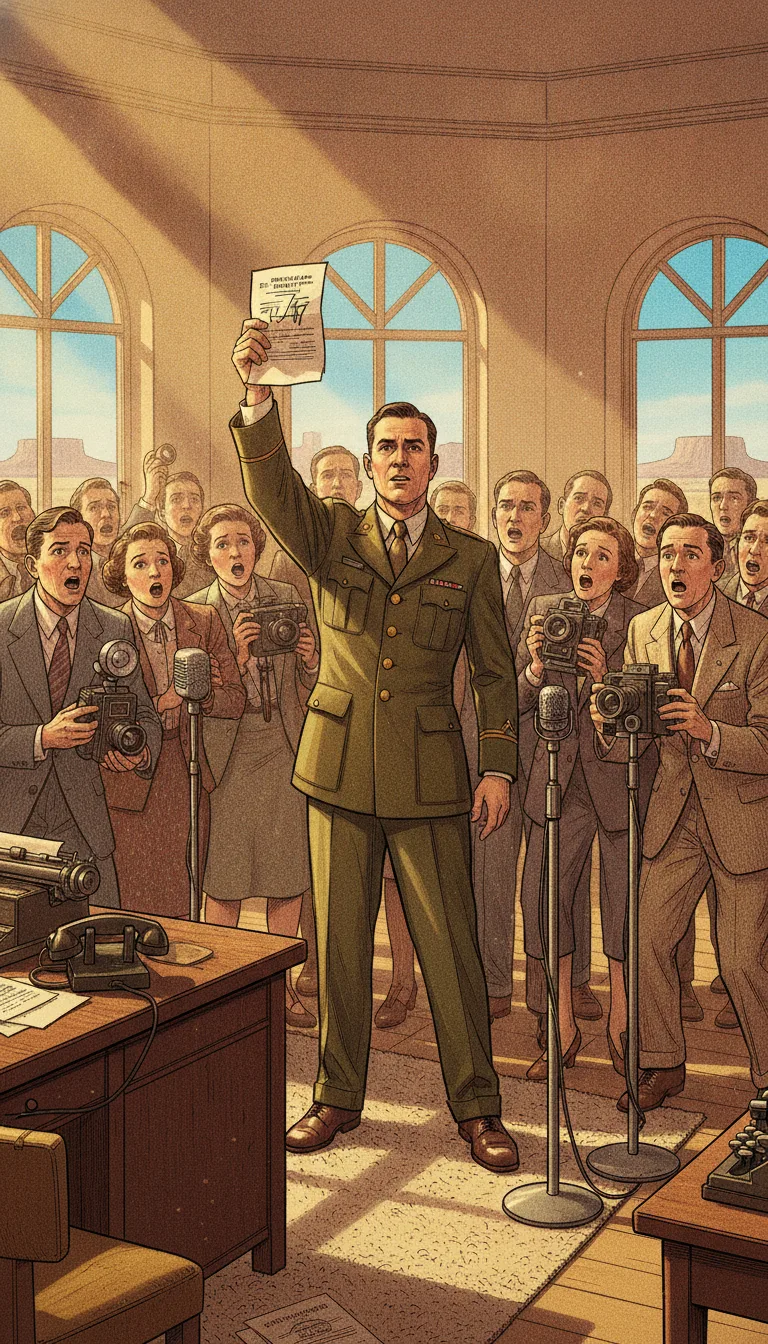
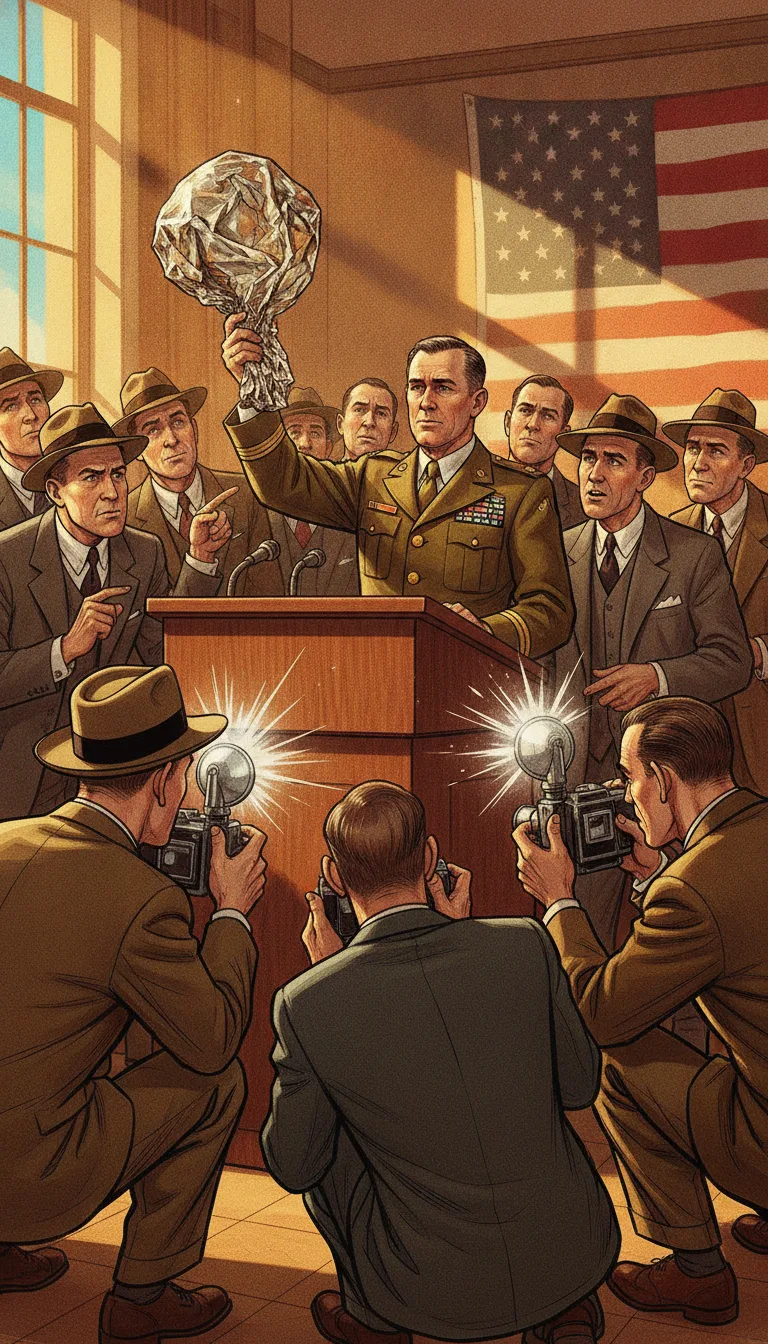
What makes Roswell genuinely remarkable in military history is that the Army publicly announced a recovery before properly identifying what it had found. Lieutenant Walter Haut, the base's public information officer, issued a press release on the orders of base commander Colonel William Blanchard. It stated plainly that the Army had recovered "a flying disc."
That release moved across wire services and into newspapers across the globe within hours. Radio stations read it on air. Reporters began calling. The story was enormous — and it was the Army itself that had started it.
Then Brigadier General Roger Ramey, commander of the Eighth Air Force in Fort Worth, Texas, stepped in. He summoned Major Jesse Marcel, the intelligence officer who had examined the debris, flew him to Fort Worth, and presented a different explanation to the press. Photographs were taken of Marcel kneeling beside wreckage — wreckage that some researchers later argued was not the same material Marcel had retrieved from the ranch. The official position became clear: what had been found was nothing more than a standard weather balloon and its radar reflector.
The reversal happened so fast it created a suspicion that never fully healed.
What Project Mogul Actually Was
The most credible and widely accepted explanation among historians is that the wreckage came from Project Mogul — a classified U.S. government program that used high-altitude balloon trains to monitor Soviet nuclear tests. These balloons carried sophisticated sensors and radar reflectors and were designed to float at specific altitudes for long periods. They were secret precisely because their purpose revealed American intelligence capabilities and fears.
If the Army admitted what had actually fallen on Mac Brazel's land, they would have been confirming the existence of a program they desperately needed to protect. A cover story — an embarrassing one, even — was strategically preferable to the truth.
Why It Still Matters
The Roswell incident is not significant because of what actually fell in that field. It is significant because of what the government's behavior taught the public. The rapid reversal, the lack of transparency, and the classified programs operating without public knowledge were not unique to Roswell — they were characteristic of an entire era of Cold War secrecy.
For decades, reasonable people looked at that pattern and concluded that when governments say "nothing to see here," the honest response is skepticism. Roswell became a symbol before it became a conspiracy theory — a symbol of the distance between what citizens are told and what is actually happening.
That gap, more than any alien, is what Roswell is really about.