A Country in Pieces
To understand why the Northern Expedition mattered, you have to understand just how broken China was.
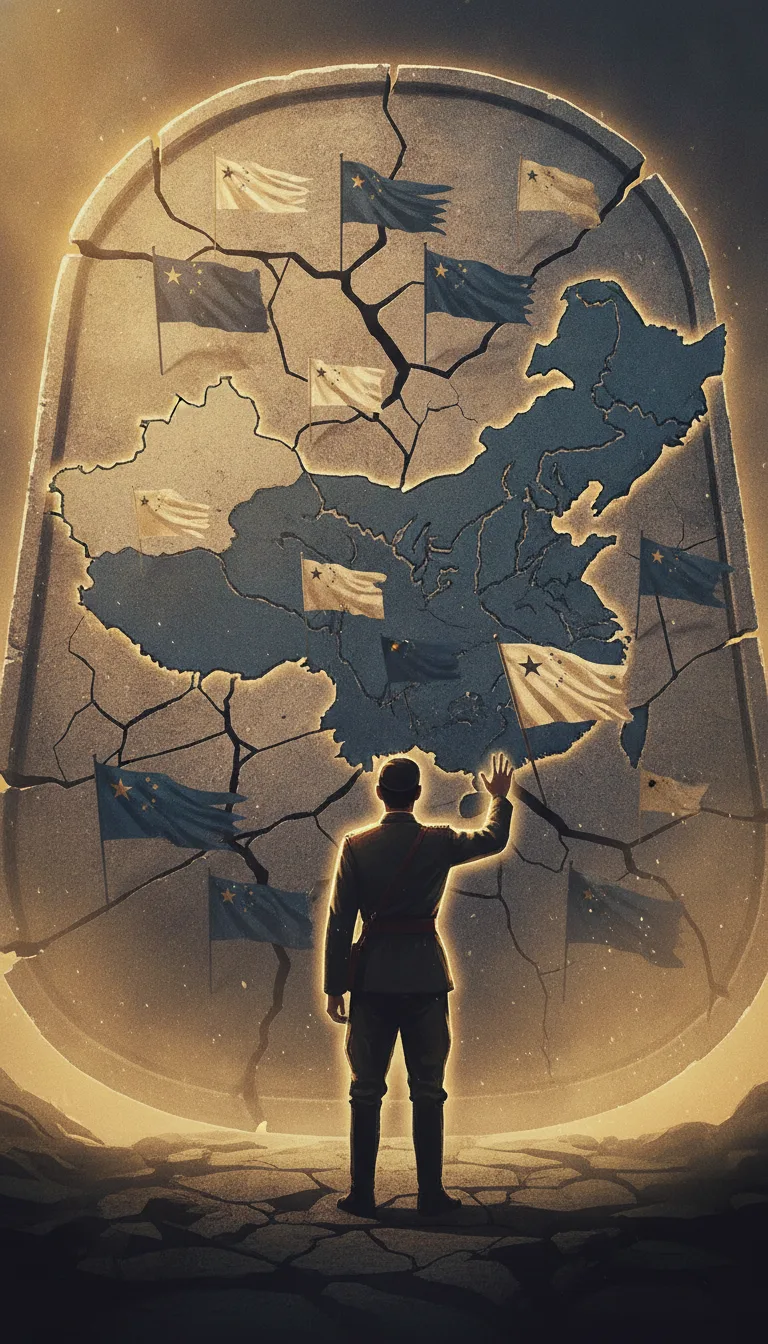
In 1912, the Qing Dynasty — the last imperial dynasty in Chinese history — collapsed after more than two centuries of rule. The Republic of China was proclaimed, but the new government never gained real control. Within years, regional military commanders filled the vacuum. These warlords commanded their own private armies, collected their own taxes, and fought constantly over territory and resources. Ordinary Chinese people lived under men like Zhang Zuolin in Manchuria, who ran his domain like a personal empire, or Sun Chuanfang in the Yangtze Delta, who controlled five provinces simultaneously.
By the mid-1920s, China had effectively fractured into dozens of competing kingdoms. Railways were cut. Trade was disrupted. Farmers were taxed multiple times by whoever happened to be passing through. Foreign powers — Britain, Japan, France — maintained their own privileged zones in Chinese cities, a humiliation dating back to the unequal treaties of the nineteenth century. China was sovereign on paper and powerless in practice.

The Man with the Plan
Chiang Kai-shek had risen through the revolutionary movement built by Sun Yat-sen, the founding father of the Republic. Sun dreamed of a unified, modern Chinese nation. When Sun died in March 1925, Chiang — trained partly at a military academy in Japan and later in the Soviet Union — positioned himself as the movement's military leader. By 1926, he held command of the National Revolutionary Army, based in the southern city of Canton (Guangzhou).
The army was not simply a military force. It was a political project. Soviet advisors, including the influential Mikhail Borodin, helped reorganize and train it. Political commissars worked alongside officers to maintain discipline and motivation — a structure borrowed directly from the Red Army model. The Nationalist Party, the Kuomintang, also maintained an alliance at this time with the young Chinese Communist Party. This uneasy coalition gave the expedition both military strength and a network of labor organizers and activists who could mobilize workers and peasants in cities ahead of the advancing troops.

The March North
The Northern Expedition launched in July 1926. Roughly 100,000 soldiers moved out of Guangdong province in three main columns, heading toward the Yangtze River. The campaign combined conventional battles with something equally powerful: political persuasion. Advance teams organized strikes and uprisings in cities before the army arrived, weakening warlord control from within. When the Nationalist forces reached Wuhan in October 1926 — less than four months after departing — the city largely fell through a combination of military pressure and internal revolt.
The battles were not bloodless. The siege of Wuchang, one of the three cities that make up the Wuhan area, lasted forty days and cost thousands of lives. But the overall momentum was remarkable. By early 1927, the Nationalists controlled the Yangtze River valley. Shanghai, China's largest and most economically vital city, fell in March 1927.
The Break That Followed
Victory brought a crisis. The alliance between the Kuomintang and the Communists had always been tense. In April 1927, Chiang made a violent and decisive move. In Shanghai, Nationalist forces — working with criminal networks and foreign-backed interests — turned on Communist organizers and left-wing labor activists. Thousands were killed in what became known as the Shanghai Massacre. The first United Front was destroyed. The Chinese Civil War, which would last with interruptions for over two decades, had effectively begun.
By 1928, Chiang's forces captured Beijing, and most major warlords had either been defeated or had nominally submitted to Nationalist authority. China was unified in name, though the Communists had retreated into the countryside and Japan was watching from the north with growing ambition.
Why It Still Matters
The Northern Expedition is easy to overlook beside the larger dramas that followed — the Japanese invasion, the Second World War, the Communist revolution of 1949. But it was the foundation. It proved that China could be pulled together, that a disciplined political-military movement could overcome fragmentation. It also planted the seeds of the conflict that would define twentieth-century China: the rivalry between Chiang Kai-shek's Nationalists and Mao Zedong's Communists, a rivalry that ended with Chiang retreating to Taiwan and Mao proclaiming the People's Republic.
One expedition. Two years. Consequences that lasted a century.